
I adopted a cat: what I learned about the environment may shock you
In which Hari is in her click-bait era, and she discusses cats, foraging and taking responsibility for nature.

I’ll be honest with you; I’ve never really understood the concept of stewardship. Like, I get it, but lots of people who’ve told me they’re stewards of the land are like, people who live on communes and wear recycled saris OR people who run for-profit foraging workshops. Sometimes both. No shade to people who do any of those things, but I don’t really know what it means when they say it – can you only be a steward of the land if you tell people they can eat the whole of a dandelion and have built a communal pond? Like what represents stewardship? Who is stewardship when she’s at home?
Cambridge Dictionary says that ‘Someone’s stewardship of something is the way in which that person controls or organizes it’. Suitably vague – thanks hun. I was a steward for a charity obstacle course once. I was really bad at it (wasn’t taught how to use the equipment so just let people crack on with whatever really) and a cow followed me ominously around a field for two hours. I can’t say that I was organised or in control in that scenario, so maybe not the ideal example. I once produced a research and development for a play; I was much better at that, and in that scenario, I was the person in (most of the) control, and I organised it. But I don’t really know if I was a steward. I was a producer. I just made it happen. I feel like stewardship is different to just making stuff happen.
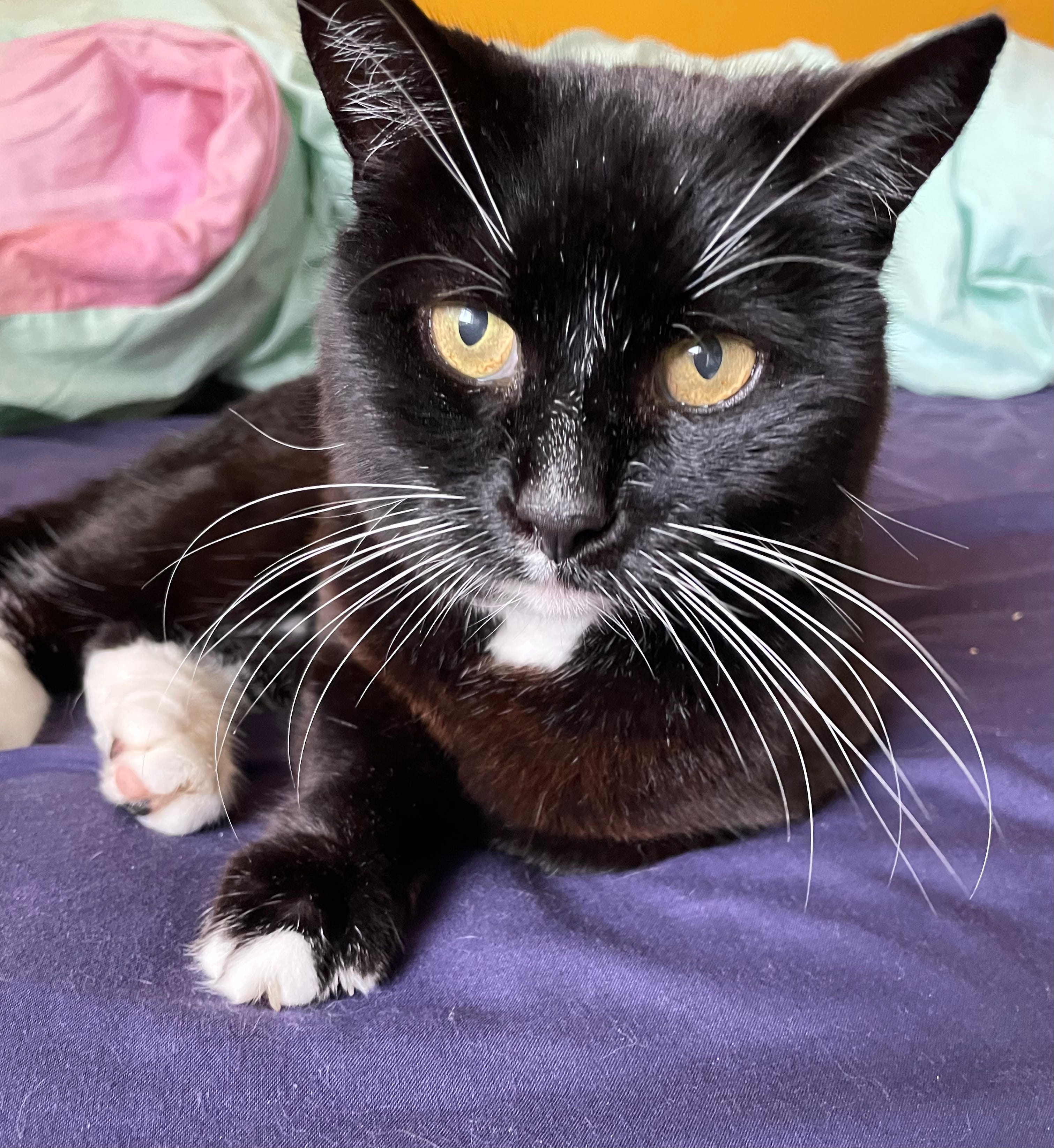
Recently, we have adopted a cat. Her name is Missy – that’s her, up there at the top, in the picture. She’s about 15 years old, we think. Maybe a bit younger and weather-beaten. We’ve actually been feeding her for many years, because she used to sleep in our garage (a converted office space), but recently she’s had some health problems and other cats have been trying to encroach on her territory, which has meant that she’s too scared to go indoors and she’s spent more time in the bad weather. All this combined: it was time for her to move in. She spent a week quarantined in my bedroom, and since then has free run of the house (though spends most of the day sleeping on my bed, which she thinks is the best thing ever invented) and goes outside to use the loo, because she’s never been litter trained. Those of you who follow me on notes will have heard a little about her already.
In other news, The Daily Mail, our favourite bollocks-peddling band of bluster-musters has run with this headline: ‘Middle class foragers are desecrating the countryside by copying influencers who romanticise berry and mushroom picking - and are even poisoning themselves in the process’, which has lead to foraging influencer Fern Freud receiving a torrent of abuse online, for her lack of aforementioned stewardship. Now, I’m not overly familiar with Fern’s work, but I do have experience of many other foraging influencers, who I respect and believe are respectful of the land, and they follow her, and clearly think the same of her. Many, including myself, are confused why The Mail chose to highlight her and other influencers, rather than highlighting the damaging shady commercial foragers who go to woodlands and strip them bare so that they can turn a profit with nearby restaurants. I’m not saying no forager ever has been too greedy – we have offered people to pick some things at the allotment and they have stripped our plants bare – but I’m just not getting the sense that the nation’s porkish anger is being directed to the right place (surprise surprise).
I get told very often that having cats is bad for the environment. People who notice you care about something more than they do love to tell you why you don’t care about it as much as you think. Cats are bad for the environment: the one down the road from us kills a rodent or bird almost every day, sometimes multiple a day. Their food contributes to greenhouse gases and they act as an invasive species when abandoned and left to be feral. In many countries where they were brought in as pest control, they are now pests. I will never stop owning cats, though, and I don’t regret adopting Missy, because my relationship with animals informs my relationship with nature, and makes me a better supporter of nature.
In a recent Instagram post on the matter, Freud said this:
Let me start by saying… Foraging draws you towards the land like nothing I’ve known before. 🌳 It breeds nature lovers, tree huggers and land advocates. The more foragers we have, the more wild spaces we will demand, the more our culture will move towards one that respects, celebrates and works in harmony with the land. 🌱☀️
And she’s right. Connecting with the land – mindfully connecting with the land, not just going to a place where you know loads of cockles are and stripping the beach – gives you an immense respect for nature. You value what you collect more because it is in short supply, and it is time limited. By valuing it, you respect it more. You are compelled to learn about it and give it more of your support and time. When you learn about it, you begin to understand what it is connected to – what it is impacted by, and what it impacts. You give it more space; you begin to worry for and feel a responsibility towards the wider area because you know all those things together make the things you love possible.
Similarly, by taking in Missy, I have learned again what it means to nurture and be nurtured. I’ve had a horrendous cold this week. Missy lays her head on my hand when I’m napping and licks my arms to clean them. She usually sleeps at the bottom of the bed, but this week has been next to me almost all night. I’m certain she knows I need support, in the same way I knew she needed it when she moved in. Tending to her has reminded me that things take time – when she first moved in, I was so worried that I wanted her to be better straight away. She slept for two days almost continuously, and I was desperate to see her thrive. Little by little, she improved, and she got more energetic, and she got more joyful, and she began to see me in the same way I saw her. And now she tends to me. And beyond that, my life has improved in other ways since she’s been here – I’m calmer in the evenings, I get more sleep. I’m more mindful of the actions and the noise I make; my house is a quieter and more peaceful place. I’m calmer and more regulated, which puts me in a better position to solve difficult problems and makes it easier for me to be an advocate. All because I adopted a cat.
So, what is stewardship then? It is recognising a mutually beneficial bond, I think, and taking responsibility to protect it. It’s not just organising and controlling, but being led and being taught. I think there are more stewards than we think. I think you’re probably a steward and you don’t even realise it.
Cats! I’m cat-sitting a foster cat for a friend. People foster cats! Did not know that was a thing.